Darwin's Bards: British and American Poetry in the Age of Evolution by John Holmes
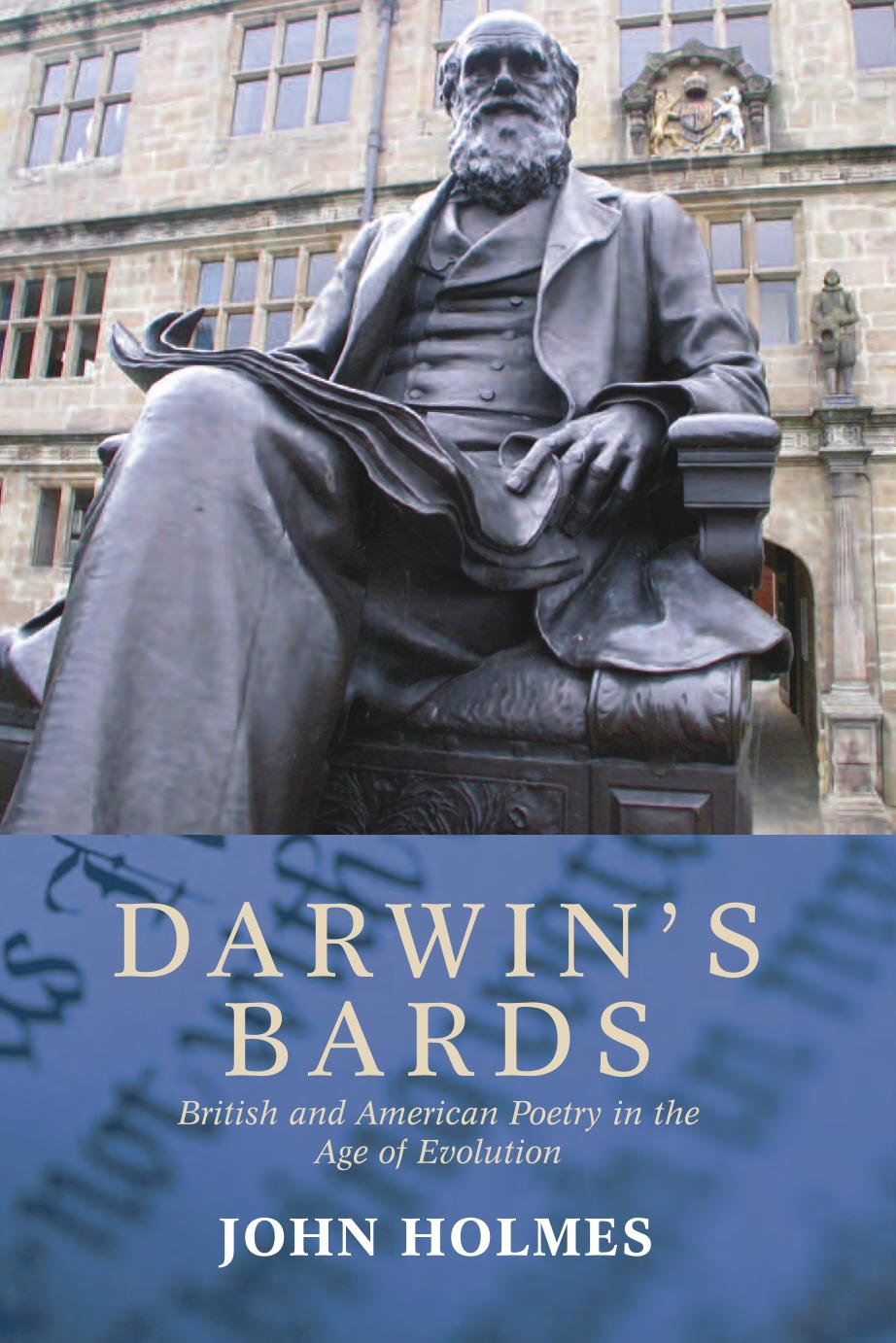
Author:John Holmes [Holmes, John]
Language: eng
Format: epub, pdf
ISBN: 9780748639403
Amazon: 0748639403
Publisher: Edinburgh University Press
Published: 0101-01-01T00:00:00+00:00
As Cecil D. Eby (1987, 42–43) has observed, these lines recall the conclusion of The War of the Worlds. Once the Martians have perished and the exiled masses have returned, the narrator finds himself unable to forget all that he has witnessed: ‘I go to London and see the busy multitudes in Fleet Street and the Strand, and it comes across my mind that they are but the ghosts of the past, haunting the streets that I have seen silent and wretched, going to and fro, phantasms in a dead city, the mockery of life in a galvanised body’ (Wells, 1898, 302). In a prefiguring of Bedford’s epiphany in The First Men in the Moon, the chronicler of the Martian attack perceives the weakness of civilisation after hearing his race as a whole compared to ants by the artilleryman (254; see also 100 for the introduction of humans as ants).
Empson’s sonnet is pervaded by a Wellsian sense of mankind’s power and vulnerability, and the promised panoramic view leads inevitably into the sestet’s verdict:
No, by too much this station the air nears.
How small a chink lets in how dire a foe.
What though the garden in one glance appears?
Winter will come and all her leaves will go.
We do not know what skeleton endures.
Carry at least her parasites below.
The octet’s assured, programmatic ‘we’ addressing ‘you’ has reduced to a single declaration of precarious unknowing. End-punctuation now enacts uncompromising self-curtailment. ‘Station’ refers us back to line four, with ‘old men running and trains whining through’. The subterranean workers (looking ancient with ‘pinched faces […] feeble muscles, and weary eyes’) may simply be in a rush, or perhaps they are shifted around like cargo on a network of escalators (in The Sleeper Awakes, transport around the city consists of moving platforms called ‘running ways’). Expansion of the underground network risks making the whole system vulnerable, while the ‘foe’ capable of entering by small chinks is left vague: it might be the outside air, or sunlight, or some rival insect – what matters is the sense of threat, rather than a specific menace. A thorough pessimism diminishes the promised garden, for it will become bare and inhospitable in winter, while uncertainty over ‘what skeleton endures’ adds a histrionic note, invoking the excessively long time scales of archaeology. ‘Carry at least her parasites below’: the insects retreat underground with a ranch of fat aphids, perhaps planning to live off the roots – a safer, yet ultimately more destructive, policy. A sense of relief and compassion is insinuated by including slightly longer words in the last two lines, a last flicker of humanity as the automata retreat. There is a private joke at the end, for Empson was interested in voyeuristic and vicarious relationships, where a thwarted lover might get pleasure from observing another’s success (see Haffenden, 2005, 117, and 2006, 388–92). Seduction of the rival, tapping this ‘parasite’, is itself a parasitical activity likely to cut off the ultimate source of honey-dew.
This is about as much as can be milked from the poem as confined to terrestrial experience.
Download
Darwin's Bards: British and American Poetry in the Age of Evolution by John Holmes.pdf
This site does not store any files on its server. We only index and link to content provided by other sites. Please contact the content providers to delete copyright contents if any and email us, we'll remove relevant links or contents immediately.
4 3 2 1: A Novel by Paul Auster(12356)
The handmaid's tale by Margaret Atwood(7732)
Giovanni's Room by James Baldwin(7305)
Asking the Right Questions: A Guide to Critical Thinking by M. Neil Browne & Stuart M. Keeley(5742)
Big Magic: Creative Living Beyond Fear by Elizabeth Gilbert(5729)
Ego Is the Enemy by Ryan Holiday(5395)
The Body: A Guide for Occupants by Bill Bryson(5066)
On Writing A Memoir of the Craft by Stephen King(4921)
Ken Follett - World without end by Ken Follett(4708)
Adulting by Kelly Williams Brown(4554)
Bluets by Maggie Nelson(4535)
Eat That Frog! by Brian Tracy(4502)
Guilty Pleasures by Laurell K Hamilton(4428)
The Poetry of Pablo Neruda by Pablo Neruda(4082)
Alive: The Story of the Andes Survivors by Piers Paul Read(4011)
White Noise - A Novel by Don DeLillo(3992)
Fingerprints of the Gods by Graham Hancock(3980)
The Book of Joy by Dalai Lama(3962)
The Bookshop by Penelope Fitzgerald(3829)
